









Zero Liquid Discharge in Chemical Manufacturing: How Archean Sets Industry Standards
Zero Liquid Discharge in Chemical Manufacturing: How Archean Sets Industry Standards
 admin
admin
 6 Minute Read
 27th May 26
Water is both the lifeblood and the greatest challenge of chemical manufacturing. Every kilogram of bromine extracted, every ton of salt produced, and every batch of derivatives manufactured generates process water that must be treated and disposed of responsibly. For decades, the chemical industry has operated under a linear model: extract, process, discharge. But a growing number of manufacturers — led by companies like Archean Chemical Industries — are embracing a radically different approach: zero liquid discharge (ZLD).
What is Zero Liquid Discharge?
Zero liquid discharge is an environmental management strategy that eliminates liquid waste from industrial processes by treating and recycling all process water within the facility. No effluent leaves the plant boundary. Instead of discharging treated wastewater into rivers, seas, or groundwater, every drop is either recirculated back into production or evaporated to recover valuable salts and minerals.
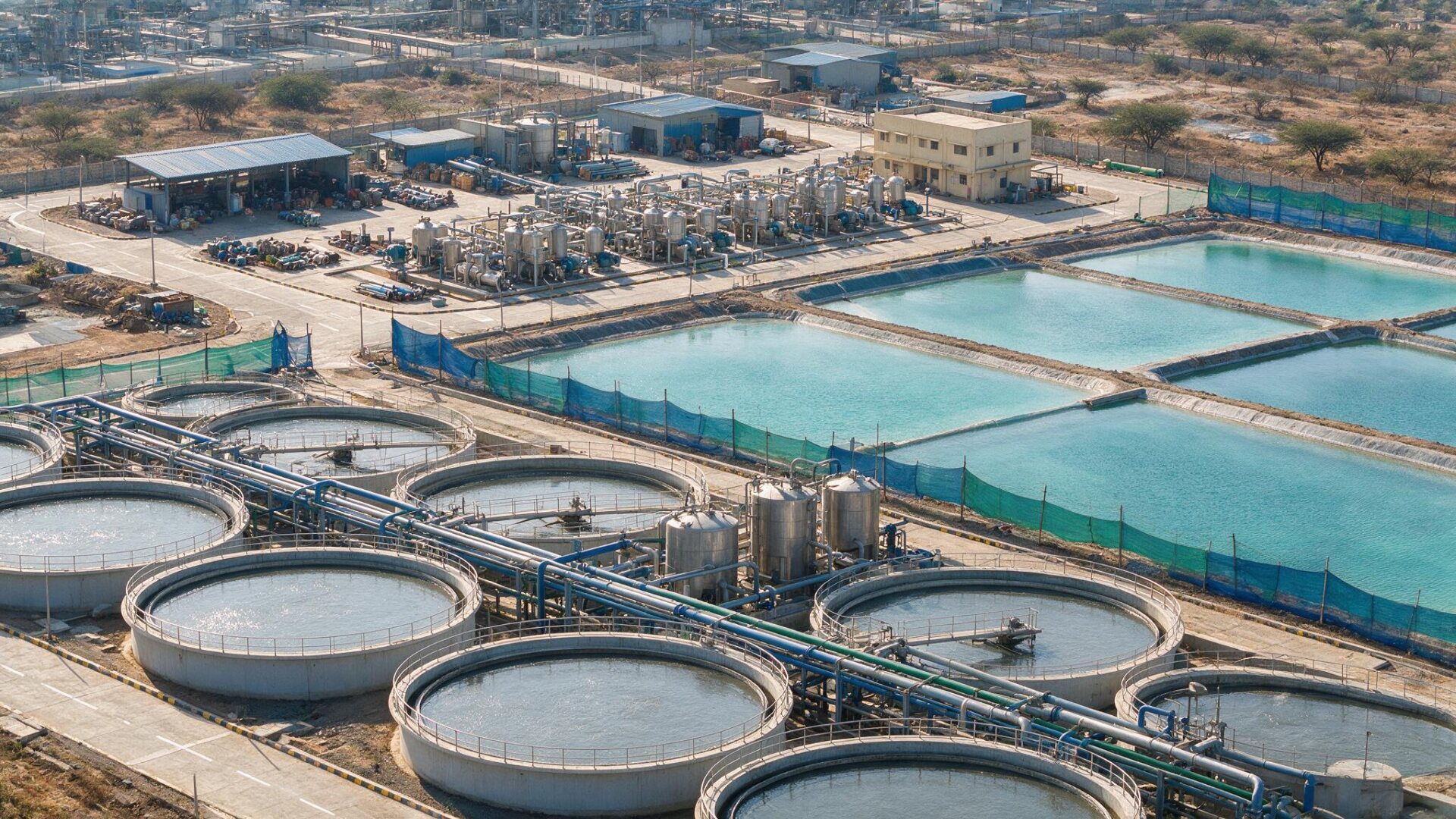
At Archean’s Hajipir plant on the Rann of Kutch, ZLD is not a theoretical aspiration — it is operational reality. The facility operates a multi-stage water treatment and recovery system that captures, treats, and recycles 100% of process water generated during bromine extraction, salt production, and derivative manufacturing.
Why ZLD Matters: Environmental and Regulatory Imperatives
The Gulf of Kutch is one of India’s most ecologically sensitive regions, home to unique mangrove ecosystems, salt marshes, and marine biodiversity. Operating responsibly in this environment is not merely a compliance matter — it is a foundational principle of Archean’s operations.
From a regulatory perspective, India’s environmental laws increasingly demand ZLD compliance for chemical manufacturers. The Ministry of Environment, Forest and Climate Change has made ZLD a requirement for new and expanding industrial facilities in water-scarce regions. Companies that adopt ZLD early position themselves ahead of regulatory curves and protect their operating licenses for the future.
But the case for ZLD extends beyond compliance. It addresses a fundamental question: how can a chemical company operate sustainably in a water-constrained world?
The Technology Behind ZLD
Archean’s ZLD system employs a multi-effect evaporation (MEE) train combined with mechanical vapor recompression (MVR) and crystallisation technology. Here’s how it works:
Process water from bromine extraction and salt production enters the treatment facility. Multi-effect evaporators progressively concentrate the water, reducing its volume while recovering valuable dissolved salts. Mechanical vapor recompression recycles the thermal energy from evaporation, dramatically reducing the energy input required. Finally, crystallisation units recover solid salts that can be repurposed or safely disposed of on land.
The result is near-total water recovery. The small volume of brine concentrate that cannot be economically recovered is managed through controlled terrestrial disposal, not discharged into marine environments.
Beyond Compliance: The Business Case for ZLD
While environmental responsibility drives ZLD adoption, the business case is equally compelling. ZLD facilities recover valuable byproducts — salts, minerals, heat energy — that would otherwise be lost to the environment. At Archean, recovered salts from the ZLD system are reused in production or sold as industrial byproducts, generating revenue and reducing waste disposal costs.
Additionally, ZLD facilities command premium valuations in capital markets. Investors recognize that ZLD-certified operations have lower environmental liability, stronger regulatory relationships, and greater license-to-operate security. This translates into easier financing, lower cost of capital, and better long-term valuations.
Water Conservation: The Multiplier Effect
At the Hajipir plant, 100% recycling of process water means the facility’s net freshwater demand is minimal. In a region where water is scarce and competition for agricultural irrigation is intense, this has profound community benefit. Archean’s manufacturing operations do not compete with farmers for limited water resources.
In FY 2025-26, Archean harvested 49,89,890 kilolitres of rainwater, supplementing its water security and reducing dependence on groundwater or external sources. Combined with ZLD recycling, this positions the facility as a model of water stewardship in an arid region.
Setting Industry Standards
Archean’s ZLD facility is certified by the Gujarat Pollution Control Board and audited annually by independent environmental agencies. The facility has become a reference point for other chemical manufacturers seeking to understand how ZLD can be implemented at scale.
More significantly, Archean’s commitment to ZLD sends a message to supply chain partners, customers, and investors: leading speciality chemical manufacturers are not merely complying with environmental regulations — they are setting new standards of environmental performance that redefine what responsible chemical manufacturing looks like.
Conclusion: The Future of Manufacturing
Zero liquid discharge is not a niche environmental strategy. It is the future of sustainable chemical manufacturing. As water scarcity intensifies globally, as environmental regulations tighten, and as customers increasingly demand sustainable supply chains, ZLD will transition from competitive advantage to industry norm.
Archean’s experience demonstrates that ZLD is technically feasible, economically viable, and operationally superior. For chemical manufacturers and their customers, the question is no longer whether to adopt ZLD, but how quickly they can make the transition.
Page Contributors
I must explain to you how all this mistaken idea of denouncing pleasure and praising pain was born and I will give you a complete account of the system, and expound the actual teachings of the great explorer of the truth, the master-builder of human happiness. No one rejects, dislikes, or avoids pleasure itself, because it is pleasure, but because those who do not know how.

The Archean Editorial Team brings together perspectives from across our businesses — sharing insights on marine chemistry, sustainability, and the industries we serve worldwide.
